Alethic architecture
How Kernel makes an application decision, how Guard grants authority on a supported host, and what each boundary covers.
How it works
From proposal to verified outcome.
Follow a proposed action through the decision, the committed record, and the operation the host observes.
Propose
A planner proposes a belief or an action.
Validate
Kernel evaluates the evidence and configured rules.
Commit
Accepted proposals become records with a decision trace.
Enforce
Where deployed, Guard mediates approved external operations from the host.
Verify
Use host observations or collector receipts to check what happened.
Explore the kernel’s seven typed slots
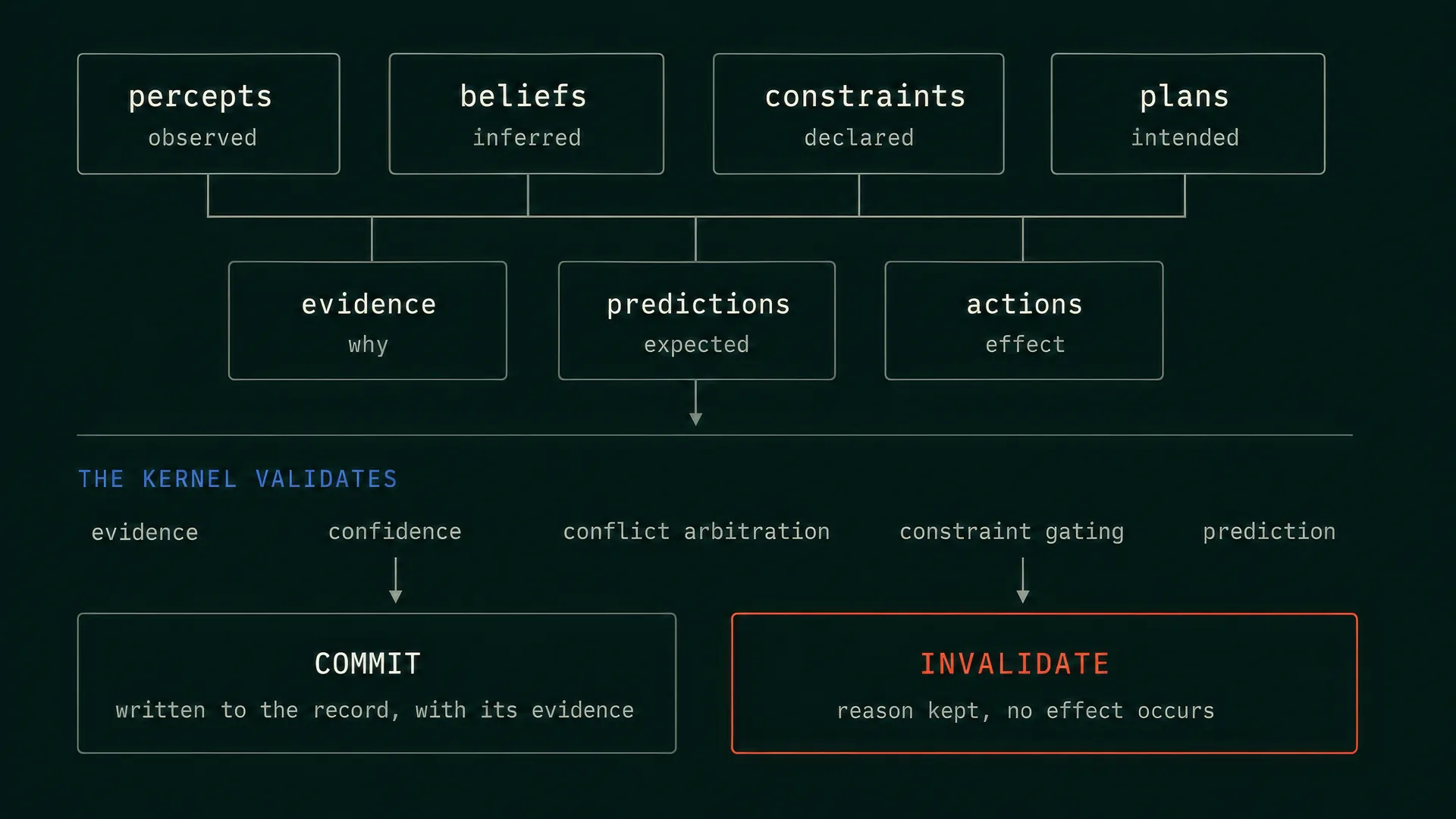
Seven typed slots
The kernel validates
evidence · confidence · conflict arbitration · constraint gating · prediction
Tools commit percepts, evidence validators commit evidence, and symbolic validators commit constraints. Governed proposals become committed state only through the kernel's deterministic validation pipeline.
What ships in the kernel
Build with governed state.
Alethic sits below the planner. Bring an LLM, rules engine, simulator or sensor—the same governance protocol applies to each.
Evidence-linked commitments
Evidence validation checks proposed beliefs before commitment.
EvidenceValidator, commit_belief_from_proposal()
Declarative action constraints
Configure rules that the kernel evaluates before committing proposed actions.
SymbolicValidator, commit_action_from_proposal()
Persistent governed state
Records are session-scoped. Beliefs and constraints accumulate across episodes and survive restarts.
SqliteStore, Session, scope="persistent"
Governed predictions
A predictions slot gives governed forward dynamics. An action can require a prediction with a non-negative outcome.
SimulatorWorker, declarative SimRule
Adaptive constraints
Configured thresholds turn recurring failures in the record into new constraints.
AdaptiveWorker, threshold-gated derivation
Composable workers
A model, rule engine, simulator, or sensor can use the same worker protocol.
Worker protocol, Orchestrator
The kernel contains zero domain-specific logic. Only workers, tools and task definitions change between domains.
Kernel assumptions
Scope and limitations.
Kernel governance applies inside the trusted application. Its decisions depend on the evidence and rules the application provides.
- 01
The controlled evaluation covers a single domain at scale. The monitoring demonstration shows the kernel generalizes with unchanged code, but formal multi-domain evaluation at 1,200 episodes is future work.
- 02
LLM planner integration has been tested with GPT-OSS-20B and Qwen3-80B. Broader model and architecture diversity remains future work.
- 03
Multi-turn dialogue, adversarial prompt injection and open-ended planning remain future work.
- 04
The simulator gives rule-based forward dynamics, not a learned world model. Its predictions are only as good as the rules you write.
- 05
The adaptive worker learns from how often a failure occurs, not from why it occurred. That is a useful heuristic, not causal inference.
- 06
The bundled SQLite store is single-process. Distributed deployments require a networked store implementation.
- 07
Run the unauthenticated kernel HTTP API only in a trusted development environment. Integrate the library directly to use its in-process guarantees.
- 08
Constraint suppression and governance bypass are misuse risks that need organizational controls, not just technical ones.